
An operator’s guide to Revenue Operations
What Is Revenue Operations (RevOps)?
Revenue Operations, or RevOps, coordinates the people, processes, data, and systems across Marketing, Sales, Customer Success, and Finance to improve how a company acquires, converts, retains, and expands customers. In product-led and hybrid businesses, that operating model also connects Product & Engineering with commercial execution.
I write from more than 15 years building and leading high-growth revenue organizations. At eLocal, I built the first Revenue Operations function, led an 80-person revenue organization, and owned scaling revenue 5× from a $25M run rate to a $125M run rate. At Dashlane, I helped scale ARR from $3M to $55M+ while building teams and systems for self-service and direct sales. Those experiences, combined with my academic background in physics and mathematics, inform the framework, examples, and decision tools in this guide. Read my operator biography →
What is Revenue Operations?
Revenue Operations creates a shared operating system for growth. It connects the teams responsible for attracting customers, delivering value, generating revenue, and protecting the economics of the business.
In practice, RevOps should help a company answer seven questions:
- Which customers can we serve unusually well?
- Where do those customers come from?
- How do they experience meaningful value?
- What helps them move from interest or usage to purchase?
- Where would human assistance improve the experience?
- What causes customers to stay, expand, contract, or leave?
- Which changes would improve profitable growth?
Those questions cross departmental boundaries. No single CRM dashboard or functional leader can answer them alone.
Forrester's description of Revenue Operations emphasizes coordinated commercial execution across the customer lifecycle. Our model makes that coordination concrete through six operating layers, with explicit Product & Engineering partnership when product usage and technical delivery affect revenue outcomes.
Revenue Operations is not just alignment
“Alignment” is useful but incomplete. Teams can agree in a meeting and still return to incompatible definitions, incentives, systems, and workflows.
RevOps makes coordination operational. It turns shared intent into:
- agreed customer and revenue definitions;
- explicit ownership and handoffs;
- measurable lifecycle stages;
- reliable data across systems;
- decision routines with named participants;
- automation that supports a defined process;
- feedback loops between customer-facing teams and Product & Engineering; and
- economics that connect activity with revenue, gross profit, and cash consequences.
Our operating principle is simple: every RevOps initiative should connect an operational change to a customer or business outcome, with a clear owner and a way to measure progress.
When does a company need Revenue Operations?
What I learned building the function at eLocal
As VP of Sales & Revenue Operations reporting to the CEO, I built the first RevOps function and team from scratch while leading an 80-person revenue organization. The work combined a Challenger sales culture with a cross-functional modernization of GTM systems, reporting, processes, organizational structure, and operating cadence.
Over three years, my organization grew from a $25M to $125M+ revenue run rate. New-business revenue grew 800%, new-business revenue per seller increased 7×, and net profit grew 7×. Most new-business revenue came through outbound prospecting; I also led the scaling of an inbound program at 10×+ return on ad spend.
These are different measures, not interchangeable descriptions of growth. They reflect the combined work of the revenue organization and its partners, not the isolated effect of a CRM implementation or of RevOps alone. The practical lesson is to connect team capability, management discipline, systems, and economics in the same operating plan.
Signs that the operating model needs attention
A company does not need to wait until it can hire a large RevOps team. It needs RevOps discipline to increase the probability of achieving the business plan. Go-to-market complexity without RevOps does not show all the opportunities, and adds to key business decision risk and customer experience risk.
Common signs include:
- Marketing, Sales, and Finance report different pipeline numbers.
- Lead or account routing depends on manual judgment and regular cleanup.
- Product usage is difficult to connect with accounts, opportunities, renewals, or expansion.
- Sales contacts users at the wrong moment—or never contacts strong-fit accounts showing meaningful intent.
- Customer Success discovers expectations that were never captured during the sale.
- Forecast calls focus on opinions because stage criteria and buyer evidence are weak.
- Leaders add tools while adoption, integration, and data quality deteriorate.
- Product priorities are debated through anecdotes rather than customer, usage, and commercial evidence.
- Growth is increasing, but acquisition efficiency, retention, or gross margin is weakening.
- The founder remains the default integration layer between functions.
The trigger is usually not company size by itself. It is the interaction of multiple revenue motions, segments, products, systems, geographies, and teams.
| Situation | Likely need |
|---|---|
| A small team with one motion and a short customer journey | A capable owner, shared definitions, and simple operating routines may be enough. |
| Several functional teams with inconsistent handoffs | Formal RevOps ownership and a prioritized operating roadmap become useful. |
| PLG or hybrid motion with large product-usage volume | Product instrumentation, account matching, lifecycle analytics, and P&E coordination become central. |
| Multiple segments, motions, or products | A shared data model, governance, planning, and differentiated workflows are usually required. |
| Scale-stage company with repeated forecasting and systems problems | An empowered RevOps leader and specialized capabilities may be justified. |
Begin by defining which decisions and workflows the function will own, influence, and support.
The Material Impact Revenue Operations Framework
The Material Impact Revenue Operations Framework has six connected layers. Companies often jump directly to systems or dashboards. The framework begins with strategy and economics so the operational design serves the business rather than the reverse.
| Layer | Decision it makes explicit |
|---|---|
| Strategy & Economics | Which customers, offers, and growth motions create durable value at attractive acquisition, delivery, and retention economics? |
| Customer Lifecycle | What must the customer experience or accomplish from initial interest through activation, purchase, renewal, and expansion? |
| Process & Ownership | Who decides, who acts, who contributes, and what happens when a handoff or normal workflow fails? |
| Data & Measurement | Which entities, events, formulas, sources, and observation windows will show whether the outcome improved? |
| Systems & Automation | What should technology record, calculate, trigger, restrict, or surface to support the agreed process? |
| Product & Engineering Feedback | How should product and technical evidence inform commercial action, and how should customer and commercial evidence inform product decisions? |
Product retains product strategy and roadmap ownership. Engineering retains technical architecture, implementation, and reliability ownership. RevOps connects their evidence and decisions with the commercial lifecycle; it does not take over either function.
These layers are not a one-time sequence. A change in strategy can require new lifecycle stages, ownership, metrics, and systems. New product behavior can expose a packaging opportunity or make an old qualification rule obsolete.
Explore the complete Material Impact Revenue Operations Framework →
How RevOps coordinates the customer lifecycle
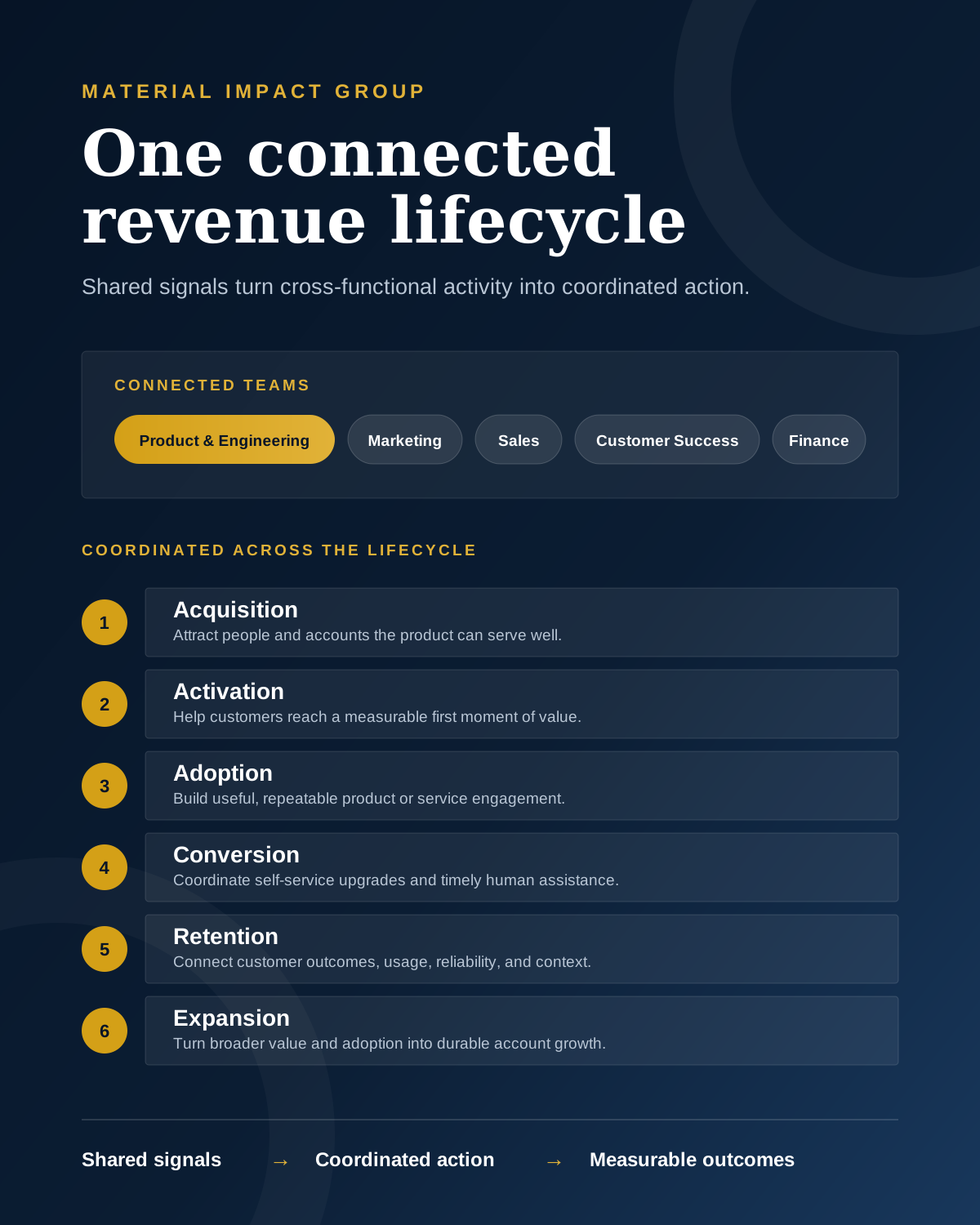
The six framework layers support a customer lifecycle that commonly includes acquisition, activation, adoption, conversion, retention, and expansion.
The order can vary. A free-trial user may activate before purchase. A sales-led enterprise customer may purchase before implementation and activation. A services customer may move through discovery, proposal, delivery, renewal, and expansion without product-usage signals.
| Lifecycle stage | Shared question | Example coordinated work |
|---|---|---|
| Acquisition | Are we attracting people and accounts the business can serve well? | Marketing and RevOps connect sources and campaigns with downstream activation, conversion, retention, and economics. |
| Activation | Has the customer reached an early moment of meaningful value? | P&E and customer teams define the milestone; Engineering instruments it; RevOps connects it to account and cohort reporting. |
| Adoption | Is the customer developing useful, repeatable behavior? | P&E, Customer Success, and RevOps investigate engagement, friction, reliability, and implementation barriers. |
| Conversion | What creates a reason to buy, and when should assistance enter? | Product, Marketing, Sales, Finance, and RevOps coordinate packages, prompts, qualification rules, and outreach ownership. |
| Retention | Is the customer continuing to receive the expected value? | Customer Success combines objectives and relationship context with product, support, delivery, and billing evidence. |
| Expansion | Where does broader value create a reason to buy more? | P&E, Sales, Customer Success, Finance, and RevOps coordinate entitlements, pricing, adoption, and account engagement. |
The objective is not to force every customer down one linear funnel. It is to understand the paths that matter, recognize meaningful signals, and give each team the context to take the right next action.
What does a Revenue Operations team do?
RevOps responsibilities depend on the business model and organizational design. A useful charter defines the decisions and workflows the function supports rather than beginning with a generic task list.
| Area | Examples of RevOps work | Business question |
|---|---|---|
| Planning | Capacity models, territory design, lifecycle targets, scenario analysis | What resources and conversion assumptions support the growth target? |
| Acquisition and qualification | Routing, account fit, scoring, product-qualified signals | Which people or accounts should receive which experience? |
| Product & Engineering coordination | Activation definitions, event instrumentation, account matching, evidence reviews | How does the product experience connect to commercial outcomes? |
| Sales execution | Opportunity stages, pipeline inspection, approvals, compensation mechanics | Where are opportunities stalling, and what must happen next? |
| Forecasting | Forecast definitions, change tracking, risk inspection, historical accuracy | How much confidence should leaders place in the forecast? |
| Customer lifecycle | Onboarding, adoption, renewal ownership, churn analysis, expansion workflows | Are customers receiving value and the right level of support? |
| Data and systems | CRM, analytics, integrations, governance, automation | Can teams follow the same customer across the business? |
| Revenue economics | Acquisition efficiency, packaging analysis, margin and cohort reporting | Which growth activities create attractive returns? |
What RevOps should own—and what it should not
Ownership must remain explicit.
RevOps may define how product activity connects to CRM records while Engineering owns instrumentation and the integration's technical reliability. RevOps may coordinate a renewal workflow while Customer Success owns the customer conversation. Finance owns accounting policy, revenue recognition, and authoritative financial reporting. Product leadership owns product strategy and roadmap prioritization.
RevOps should not become the permanent owner of every spreadsheet, tool request, and cross-functional disagreement. Its highest-value work improves the operating system: the definitions, decisions, workflows, and evidence that many people rely on.
See Revenue Operations team structures, roles, and ownership models →
What are the benefits of Revenue Operations?
The benefits of RevOps come from changing how work gets done. Better information matters when teams use it to make better decisions.
More useful forecasts
Clear opportunity criteria and buyer milestones improve the evidence behind a sales forecast. PLG and hybrid businesses may also need to model self-service conversion, existing-customer expansion, usage-based revenue, and churn without counting the same revenue twice.
Measure progress: Compare forecasts captured at a fixed point with actual outcomes. Track absolute error and persistent over- or underestimation by motion and segment.
Better conversion from existing demand and usage
Conversion problems can occur before a sales conversation or inside the customer experience. Routing errors, delayed follow-up, weak positioning, difficult onboarding, an unclear package boundary, and missing product capability require different responses.
Measure progress: Track stage conversion by source, segment, motion, and cohort. Keep definitions stable long enough for the underlying customer journey to mature.
Faster progress toward customer value
Shared activation criteria help Product & Engineering, Marketing, and Customer Success agree on what a successful start looks like. Teams can then investigate where customers stall and coordinate education, product changes, implementation help, or human assistance.
Measure progress: Track activation rate and time to first value, then test whether those signals are associated with continued usage, retention, and purchase.
Better Product, Engineering, and commercial decisions
Product & Engineering benefit from understanding lost opportunities, onboarding issues, churn reasons, expansion requests, and commercial significance in context. Commercial teams benefit from understanding product capabilities, adoption patterns, technical constraints, reliability, and delivery dependencies.
Measure progress: Review patterns by segment, frequency, customer impact, and economic value. Avoid allowing one loud request to substitute for a clear decision process.
Stronger retention and expansion
Customer objectives, adoption, support history, product reliability, relationship context, and commercial data create a more useful basis for account planning than any signal alone.
Measure progress: Track gross and net revenue retention, expansion, contraction, and churn reasons alongside adoption and customer-outcome evidence.
Better allocation of growth spending
Connecting acquisition with activation, conversion, retention, gross margin, and delivery cost helps leaders distinguish volume from durable value.
Measure progress: Compare acquisition cost and downstream gross profit by segment or cohort. Separate reclaimed employee time from realized cash savings.
A Revenue Operations example: connecting activation to paid conversion
Consider a hypothetical B2B subscription business with a free trial. These figures illustrate the arithmetic; they are not client results or a forecast.
Assume a cohort of 1,000 new trial accounts has 60 days to activate and convert. In this simplified example, every paying account first reaches the defined activation milestone.
| Metric | Starting scenario | Improved scenario |
|---|---|---|
| New trial accounts | 1,000 | 1,000 |
| Activation rate | 40% | 50% |
| Activated accounts | 400 | 500 |
| Activated-to-paid conversion | 10% | 12% |
| New paying accounts | 40 | 60 |
| ARR per new paying account | $12,000 | $12,000 |
| New ARR booked from the cohort | $480,000 | $720,000 |
The calculation is:
Trial accounts × activation rate × activated-to-paid conversion × ARR per paying account = new ARR booked
A 10-percentage-point improvement in activation and a 2-percentage-point improvement in activated-to-paid conversion produce $240,000 more new ARR—a 50% increase—with the same trial volume.
The coordinated work might involve Product simplifying setup, Engineering implementing the change and instrumenting completion events, Marketing improving trial education, Customer Success helping accounts overcome implementation issues, and Sales assisting suitable accounts with a purchase decision. RevOps connects the definitions, signals, ownership, and measurement.
The arithmetic does not establish that these actions will produce the assumed improvement. Results depend on customer fit, pricing, execution, costs, retention, and other factors. Booked ARR is also different from cash collected or revenue recognized during the period.
Which Revenue Operations metrics matter?
Start with the decision, not the dashboard. A company should not track every available number with equal attention.
Useful RevOps metrics commonly fall into five groups:
- Acquisition: qualified demand, customer acquisition cost, source-to-outcome conversion.
- Activation and adoption: activation rate, time to first value, depth and breadth of useful adoption.
- Conversion and pipeline: lead/account conversion, opportunity win rate, sales cycle, pipeline coverage, forecast error.
- Retention and expansion: gross revenue retention, net revenue retention, renewal rate, contraction, expansion, and churn reasons.
- Economics: gross margin, payback, contribution profit, cost to serve, and cash consequences.
A metric needs a defined entity, numerator, denominator, observation window, source, owner, and intended decision. “Conversion rate” is not a sufficient definition. Conversion of what, into what, over which period, for which cohort?
Use the complete Revenue Operations metrics guide and formulas →
What belongs in a Revenue Operations tech stack?
A RevOps stack should support the customer and revenue lifecycle, not mirror a vendor category map.
Common capabilities include:
- customer relationship management;
- marketing automation and campaign measurement;
- product analytics and event collection;
- customer success, support, and service delivery;
- billing, subscription, and payment systems;
- data integration, identity resolution, and transformation;
- business intelligence and financial reporting;
- forecasting, conversation intelligence, and enablement; and
- workflow automation and governed AI assistance.
The difficult work is connecting people, accounts, usage, opportunities, contracts, invoices, and outcomes across those systems. Before adding software, define the process, the system of record, the data owner, the required integration, and the decision the tool should improve.
Learn how to design and audit a Revenue Operations tech stack →
Revenue Operations vs. Sales Operations
Sales Operations improves the systems, process, planning, and execution of the sales function. Revenue Operations coordinates the broader customer and revenue lifecycle across several functions, especially across GTM functions.
| Function | Primary scope | Typical examples |
|---|---|---|
| Sales Operations | Sales team performance and execution | Territories, quotas, compensation administration, opportunity process, pipeline reporting |
| Product Operations | How the product organization works and uses evidence | Research operations, feedback systems, product-team workflows, planning routines |
| Revenue Operations | Cross-functional customer and revenue lifecycle | Acquisition through expansion definitions, integrated data, planning, handoffs, forecasting |
| Fractional CRO | Part-time executive leadership for revenue strategy and performance | Set priorities, coach leaders, align functions, oversee execution and accountability |
RevOps becomes more valuable when the important problems span functions, motions, and systems.
I believe that RevOps should fully grasp the entire business model and revenue engine to offer key visibility of the funnels, cycles, and loops, and distill and identify the highest impact opportunities to drive incremental growth outcomes. For example, mapping the journey from market segmentation, targeting, marketing impression, lead capture, lead scoring, sales process, product/service usage, payment collection, renewal and expansion, etc. RevOps teams should discover all the growth levers across the revenue engine and determine how and when to pull them for the best bang-for-buck.
Compare Revenue Operations and Sales Operations in detail →
Revenue Operations for product-led growth
In a product-led growth motion, RevOps connects how people use the product with how the business acquires, converts, retains, and expands customers.
A signup is an early event, not an outcome. The important questions are whether the user reaches value, develops useful behavior, brings colleagues into the account, encounters a meaningful package boundary, and has a reason to pay or expand.
That requires coordination among Product & Engineering, Marketing, Sales, Customer Success, Finance, and RevOps. It also requires restraint: product activity can indicate relevance or need, but it does not prove willingness to buy.
Read the complete guide to RevOps for PLG →
Revenue Operations best practices
Begin with a consequential business problem
“Clean the CRM” is not a business outcome. “Reduce qualified-account response time without increasing low-value outreach” connects operational work to an observable result.
Define the customer unit before the metric
Decide whether the unit is a person, account, workspace, subscription, location, project, or household. Many reporting disagreements are identity problems disguised as formula problems.
Separate evidence from judgment
Systems can surface behavior, risk, and history. People still need to interpret context, assess tradeoffs, and make decisions. Automation should make judgment better informed—not invisible.
Assign one accountable owner
Many teams may contribute to a workflow. One role should remain accountable for its health and improvement.
Design the exception path
The normal workflow is rarely the whole problem. Define what happens when data is missing, ownership is disputed, an account spans segments, a renewal is atypical, or a product signal conflicts with relationship context.
Measure adoption of the operating change
Before expecting a revenue result, verify that the new definition, workflow, or review is actually being used. Track process adoption separately from business outcomes.
Preserve observation windows
Do not declare a change successful before enough customers have had time to activate, buy, renew, or expand.
Common Revenue Operations mistakes
- Buying software before defining the decision and process. The tool then automates ambiguity.
- Treating CRM administration as the whole function. Systems matter, but so do strategy, economics, lifecycle design, and accountability.
- Centralizing every decision in RevOps. The function should enable accountable teams, not become a permanent queue.
- Using activity as a substitute for value. More meetings, tasks, messages, or dashboards do not prove a better customer or business outcome.
- Overfitting a process to one segment. Enterprise, SMB, partner, self-service, and usage-based motions may need different paths inside a shared model.
- Ignoring Product & Engineering. In PLG and hybrid models, the product experience is part of the revenue system.
- Changing definitions without change management. Historical comparisons break and trust declines when teams do not understand the change.
- Claiming causation from a before-and-after chart. Customer mix, seasonality, pricing, product changes, and sales capacity may also explain the result.
Where should you start with RevOps?
Start where operational friction is likely to affect a meaningful customer or business outcome.
| Symptom | First place to investigate | Possible first deliverable |
|---|---|---|
| Many signups, little meaningful usage | Acquisition fit and onboarding drop-off | Activation definition and cohort baseline |
| Healthy usage, weak paid conversion | Packaging, upgrade path, willingness to pay | Conversion analysis by fit and usage |
| P&E and commercial teams disagree about priorities | Lost opportunities, adoption barriers, churn, technical dependencies | Shared evidence review with decision ownership |
| Sales contacts users at the wrong time | Qualification signals, account matching, outreach rules | Pilot engagement workflow with guardrails |
| Plenty of inquiries, few sales conversations | Routing, response time, qualification | Ownership rules and exception report |
| Repeated missed forecasts | Stage evidence, close-date changes, motion assumptions | Forecast definitions and recurring inspection |
| Conflicting dashboards | Identity, metric definitions, sources, filters | Metric dictionary and account mapping |
Before selecting a project, ask: What is breaking, what is the likely impact, what evidence supports the diagnosis, and who can change it?
A practical first 90 days
Days 1–30: Establish the baseline
Map the customer lifecycle with Product & Engineering, Marketing, Sales, Customer Success, and Finance. Agree on essential definitions. Follow a sample of real customers through product, CRM, support, contracting, and billing systems. Select one consequential breakdown and assign owners.
Deliverables may include:
- a lifecycle map;
- a short metric dictionary;
- a systems-and-ownership map;
- a baseline cohort or pipeline analysis;
- a prioritized problem statement; and
- an implementation charter with one accountable owner.
Days 31–60: Implement a focused change
Pilot one or two improvements, such as activation support, qualification and routing, clearer opportunity criteria, or a renewal-risk workflow. Document the process, train the people involved, and monitor exceptions. Agree on the outcome measure and guardrails before evaluating results.
Days 61–90: Evaluate and refine
Compare results with the baseline while accounting for customer mix, observation windows, and concurrent changes. Decide whether to expand, revise, or stop the initiative. Establish a recurring review that connects customer, product, commercial, and financial evidence with the next decision.
Early progress may appear in workflow adoption, response time, data completeness, or activation. Revenue and retention effects need observation periods that reflect the business's purchase and renewal cycles.
Frequently asked questions
Is Revenue Operations just CRM administration?
No. CRM administration is one component. RevOps also includes planning, lifecycle design, ownership, Product & Engineering coordination, measurement, systems architecture, economics, and cross-functional execution.
Does Revenue Operations include Product & Engineering?
At Material Impact Group, yes. The product experience and its technical delivery influence acquisition, activation, conversion, retention, and expansion. RevOps connects P&E and commercial workflows while Product retains product strategy and roadmap ownership and Engineering retains technical architecture, implementation, and reliability ownership.
Does a small business need a RevOps team?
A small business can apply RevOps principles without creating a department. Begin with shared definitions, clear handoffs, an accountable owner, and a small number of useful metrics. Dedicated staffing becomes more useful as complexity and workload increase.
Who should Revenue Operations report to?
The right reporting line depends on the company. RevOps needs executive sponsorship, access to cross-functional evidence, and enough authority to improve shared workflows. The function should not optimize one department at the expense of the lifecycle.
How do you measure the ROI of RevOps?
Estimate incremental gross profit and realized cost savings associated with the change, then subtract implementation and ongoing costs over a defined period. Keep revenue, profit, reclaimed time, and cash savings separate. When several changes occur together, state the limits of attribution.
Is RevOps the same as go-to-market operations?
The terms sometimes overlap. GTM Operations often emphasizes execution across Marketing, Sales, and Customer Success. Revenue Operations can include the same work while explicitly connecting it to revenue economics, Finance, and—as in Material Impact Group's approach—Product & Engineering.
Revenue Operations support from Material Impact Group
Material Impact Group helps founders connect revenue strategy with day-to-day execution through fractional CRO leadership and GTM and RevOps advisory.
Andrew Kurau has more than 15 years of experience building and leading full-scope revenue organizations. His operating experience includes scaling Dashlane's ARR from approximately $3 million to more than $55 million and leading an eLocal revenue organization from a $25M to $125M+ revenue run rate while materially improving profit. At eLocal, he built and led an 80-person revenue organization across Sales, Sales Development and Enablement, Customer Success and Account Management, Revenue Operations, and B2B Marketing.
The work begins with a practical question: What is preventing the business from turning its demand, product value, talent, and customer relationships into stronger results?
That may mean improving activation, clarifying when Sales should engage, strengthening pipeline discipline, redesigning a team or tech stack, or creating a shared operating rhythm between Product & Engineering and commercial teams.
Talk through your Revenue Operations challenge with Material Impact Group →