
Revenue Operations Field Guide
The Material Impact Revenue Operations Framework
A Revenue Operations framework is the operating model a company uses to connect revenue strategy with the people, processes, data, technology, and decisions that shape the customer lifecycle.
The best-known RevOps problems often appear in systems: a broken dashboard, inconsistent CRM records, duplicate accounts, or a routing rule that fails. But those symptoms usually begin earlier. The strategy may be unclear. Teams may define the lifecycle differently. Ownership may be missing. The company may be measuring an internal activity instead of customer progress.
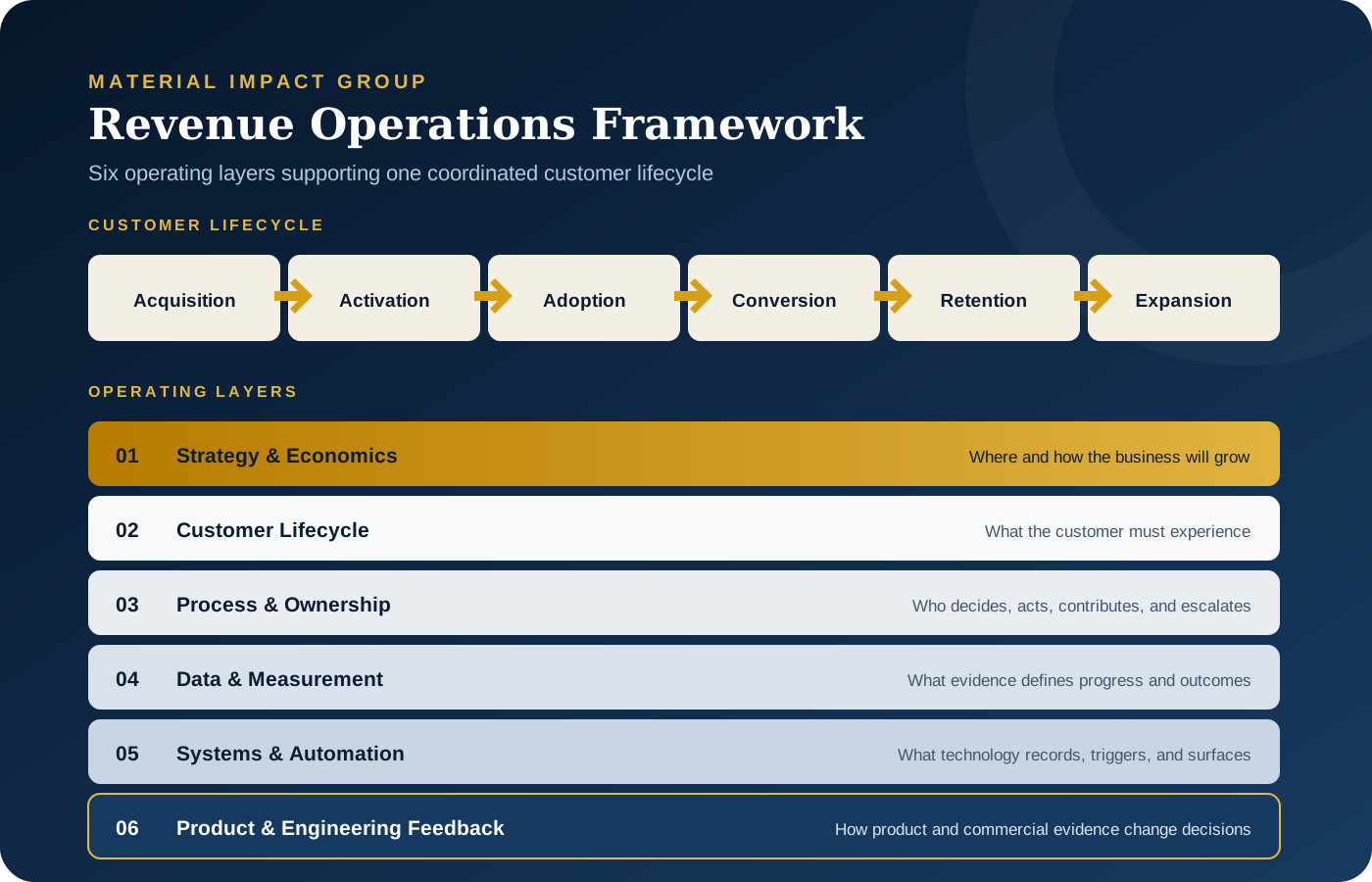
The Material Impact Revenue Operations Framework addresses that problem through six connected layers:
- Strategy & Economics
- Customer Lifecycle
- Process & Ownership
- Data & Measurement
- Systems & Automation
- Product & Engineering Feedback
It supports the broader operating model described in our complete guide to Revenue Operations, while providing a practical sequence for designing or repairing RevOps.
Common reasons RevOps frameworks fail in execution
Many frameworks correctly call for alignment across Marketing, Sales, and Customer Success. The difficulty is turning that idea into operating decisions.
Five failure patterns are common:
The framework begins with tools
The company buys a platform, then tries to reshape its process around the software's default objects and workflows. The implementation may be technically sound and strategically wrong.
The framework mirrors the org chart
Department stages are substituted for the customer journey. Marketing “owns” the top, Sales the middle, and Customer Success the end, even when the customer moves back and forth or experiences Product before any human interaction.
Ownership remains collective
Several teams are named, but no one is accountable for the decision or workflow. Collaboration becomes delay.
Metrics are labels rather than definitions
Terms such as qualified lead, activation, pipeline, churn, and sourced revenue appear in dashboards without stable formulas, windows, or source rules.
Product & Engineering sit outside the model
In a product-led or hybrid business, usage, onboarding, reliability, packaging, and entitlements influence revenue. A framework that excludes P&E cannot explain or improve much of the lifecycle.
The framework below starts with business intent and customer reality. Technology enters only after the operating requirements are clear.
The six layers of the framework
1. Strategy & Economics
This layer defines where the company will compete, how it will create value, and what type of growth is economically attractive.
Decisions in this layer
- Ideal customer profile and exclusion criteria
- Segmentation and account tiers
- Product, service, and package strategy
- Pricing and discount guardrails
- Self-service, sales-assisted, partner, and hybrid routes to market
- Revenue, gross-margin, retention, and cash objectives
- Capacity and productivity assumptions
- Investment choices across acquisition, product, delivery, and customer growth
Required outputs
- A written growth thesis
- Clear segment definitions
- An agreed route-to-market model
- Economic guardrails by motion or segment
- A small set of company-level outcomes
Diagnostic questions
- Which customers receive the greatest value from us?
- Which customers produce attractive economics after acquisition and delivery costs?
- Are teams pursuing volume that does not retain or generate sufficient gross profit?
- Does pricing reflect the value and cost structure of the offer?
- Which assumptions must be true for the operating plan to work?
If this layer is unclear, downstream process work becomes local optimization. A faster handoff is not valuable if it sends more of the wrong customers into an unattractive motion.
2. Customer Lifecycle
This layer defines how a suitable customer discovers, evaluates, experiences, buys, uses, renews, and expands with the company.
Decisions in this layer
- Which lifecycle stages matter for each revenue motion
- What customer progress means at each stage
- Which events mark entry and exit
- Where customers commonly stall or leave
- When human assistance helps
- Where self-service is preferable
- How journeys differ by segment, product, or use case
Required outputs
- A customer-centered lifecycle map
- Stage entry and exit criteria
- Critical moments of value, risk, and intent
- Defined pathways for material motions and segments
- Documented failure and exception paths
Diagnostic questions
- Does the lifecycle describe the customer's progress or our departments?
- Can a customer move backward or skip stages, and can the model represent that?
- Are activation, adoption, conversion, renewal, and expansion observable?
- Do Sales, Product, Customer Success, and Finance recognize the same journey?
A lifecycle is not the same as a CRM funnel. It can include behavior and outcomes that occur before, during, or after an opportunity exists.
3. Process & Ownership
This layer converts the customer lifecycle into repeatable work.
Decisions in this layer
- Who owns each decision and action
- Which teams contribute or must be consulted
- What information must be present at a handoff
- What response or completion time is appropriate
- Which approvals are necessary
- What happens when the normal path fails
- Which recurring reviews govern the process
Required outputs
- Workflow maps with accountable owners
- Handoff criteria and service expectations
- Decision rights and escalation paths
- Exception queues and recovery processes
- Meeting charters tied to decisions
Diagnostic questions
- Is one person accountable, even when several teams participate?
- Does the process rely on memory or heroics?
- Are approvals protecting a real risk or preserving history?
- Where does work wait, loop, or disappear?
- Which exceptions create the greatest customer or financial cost?
One useful ownership format is DACI: Driver, Approver, Contributors, and Informed. The label matters less than making the decision authority visible.
4. Data & Measurement
This layer defines what the company needs to know, how it will know it, and how trustworthy that evidence must be for the intended decision.
Decisions in this layer
- Core entities: person, account, workspace, opportunity, subscription, invoice, product instance, or project
- Identity and matching rules
- Lifecycle event definitions
- Metric formulas and observation windows
- Source-of-truth systems
- Data ownership and quality expectations
- Historical-change requirements
- Access, privacy, and retention rules
Required outputs
- A shared metric dictionary
- An entity and relationship map
- Source and field ownership
- Data-quality controls
- Decision-focused dashboards or reports
Diagnostic questions
- Are teams measuring the same entity and cohort?
- Can the company connect acquisition, product, sales, support, billing, and retention evidence at the appropriate level?
- Are important changes preserved, or does each record only show the latest state?
- Which data must be exact, and which may be directional?
- What decision changes when the metric changes?
Data quality should be proportional to the decision. Compensation, billing, and financial reporting require tighter control than an early exploratory analysis.
5. Systems & Automation
This layer configures technology to support the operating model.
Decisions in this layer
- System of record for each core entity and process
- Integration patterns and synchronization direction
- Workflow triggers, actions, and safeguards
- Permissions and change control
- Human review requirements
- Monitoring, error handling, and recovery
- Buy, build, consolidate, or retire choices
Required outputs
- A capability and systems map
- Integration and ownership documentation
- Prioritized automation backlog
- Access and change-management standards
- Monitoring and exception handling
Diagnostic questions
- Which system is authoritative when values conflict?
- Is automation acting on a stable definition and reliable event?
- Can a person understand why a workflow made a decision?
- What happens when the integration or model fails?
- Is the tool used enough to justify its cost and complexity?
Automation should remove low-value friction and surface good judgment. It should not conceal unclear ownership or accelerate a broken process.
6. Product & Engineering Feedback
This layer creates a structured exchange between product, technical, customer, commercial, and financial evidence.
Decisions in this layer
- Which usage and reliability signals matter commercially
- How customer and commercial feedback is categorized and contextualized
- How product changes affect lifecycle definitions and workflows
- How roadmap, packaging, entitlement, and integration decisions are reviewed
- Which technical dependencies constrain revenue initiatives
- How product-qualified signals are validated and governed
Required outputs
- Shared evidence-review routines
- Product-event and account mapping
- Feedback categories with customer and commercial context
- Change communication for relevant product and data events
- Clear P&E and RevOps ownership boundaries
Diagnostic questions
- Can P&E see the customer and commercial significance of recurring friction?
- Can commercial teams interpret product behavior without overclaiming intent?
- Are lost deals and churn reasons standardized enough to reveal patterns?
- Do product releases update related data, lifecycle, enablement, and customer workflows?
- Are technical limitations and reliability issues visible in account decisions?
Product leads product strategy and roadmap prioritization. Engineering leads technical architecture, implementation, and reliability. RevOps connects shared evidence and downstream operating implications.
How the framework supports the customer lifecycle
The six framework layers and six lifecycle stages answer different questions. The lifecycle describes where the customer is progressing. The framework describes what the company must coordinate to support that progress.
| Lifecycle | Strategy & economics | Process & ownership | Data, systems, and P&E feedback |
|---|---|---|---|
| Acquisition | Target segments and acceptable acquisition economics | Campaign, inbound, outbound, and partner ownership | Source capture, identity, fit signals, downstream cohort outcomes |
| Activation | Value proposition and intended first value | Onboarding, implementation, education, assistance | Product/service milestones, time to value, friction and reliability evidence |
| Adoption | Behaviors associated with recurring value | Engagement and obstacle-resolution workflows | Depth, breadth, frequency, quality, and account-level usage |
| Conversion | Packages, pricing, and assisted vs. self-service motion | Qualification, routing, sales, approvals, contracting | Intent and fit evidence, opportunities, entitlements, billing |
| Retention | Value realization and economic retention goals | Success planning, risk response, renewal | Adoption, outcomes, support, relationship, contract, and payment evidence |
| Expansion | Expansion thesis and package logic | Account planning, signals, outreach, approvals | New users/use cases, limits, organizational penetration, expansion history |
The same framework can support sales-led services, transactional businesses, subscriptions, marketplaces, and product-led software. The entities, stages, and evidence will differ.
How to build a Revenue Operations framework
Step 1: Select one business outcome and one customer journey
Do not begin by redesigning the entire company. Choose a meaningful problem such as weak new-customer activation, low qualified-to-opportunity conversion, poor forecast accuracy, or preventable renewal risk.
Write the problem as an observable gap:
Strong-fit trial accounts are reaching the activation milestone, but few enter a paid or assisted conversion path within 30 days.
That is more actionable than “improve RevOps.”
Step 2: Establish the baseline
Inspect both aggregate data and a sample of individual customer records. The aggregate shows the pattern; the records reveal how the process actually behaved.
Record:
- cohort and time period;
- current outcome;
- important segments;
- missing or unreliable evidence;
- customer friction;
- process delays and exceptions; and
- known concurrent changes.
Step 3: Map the customer path
Document what the customer does, sees, receives, and needs—not only what internal teams do. Mark value moments, decisions, waits, handoffs, failure points, and exits.
Step 4: Define ownership and decision rights
Name the accountable role for the workflow and the approver for material changes. Define contributors from P&E, Marketing, Sales, Customer Success, Finance, or other functions.
Step 5: Define the minimum evidence
Choose the smallest set of metrics and fields that can diagnose the problem and evaluate the change. Write the formulas and windows before building the dashboard.
Step 6: Configure the system and workflow
Implement only the technology needed for the first operating change. Include monitoring, exceptions, and a manual recovery path.
Step 7: Run a decision-focused review
Every recurring meeting should have a decision purpose. A useful review asks:
- What changed?
- Is it real, and for which customers?
- What most likely explains it?
- What will we do?
- Who owns the action?
- When will enough evidence exist to evaluate it?
Step 8: Expand deliberately
Once the first workflow is adopted and producing reliable evidence, expand to the next highest-value constraint. Preserve shared definitions and architectural principles, but do not assume every segment needs the same workflow.
A four-level RevOps maturity model
Maturity should describe operating capability, not tool count or team size.
| Level | Characteristics | Next priority |
|---|---|---|
| 1. Reactive | Definitions vary, data is reconciled manually, leaders solve exceptions, systems mirror departmental needs | Establish lifecycle definitions, accountable owners, and a small reliable baseline |
| 2. Repeatable | Core workflows are documented, major systems connect, essential metrics are stable, recurring reviews exist | Improve exception handling, historical data, cross-functional measures, and adoption |
| 3. Integrated | Teams use shared lifecycle evidence, product and commercial data connect, planning and forecasting are coordinated | Improve segmentation, experimentation, economic measurement, and proactive plays |
| 4. Adaptive | The operating model responds quickly to strategy and customer evidence, automation is governed, learning compounds | Preserve simplicity, audit unintended effects, and keep accountability human |
A company may be mature in one motion and reactive in another. Score the actual capability by lifecycle or workflow rather than assigning one flattering company-wide label.
A 90-day framework implementation example
Consider a hypothetical product-led software company whose strong-fit trial accounts activate but rarely convert.
Here is a filled operating brief using all six layers. It is an illustrative design, not a client result.
| Layer | Decision in this example | Deliverable |
|---|---|---|
| Strategy & Economics | Test whether assistance creates incremental gross profit for strong-fit team accounts | Eligible segment, assistance cost, and minimum worthwhile improvement agreed before launch |
| Customer Lifecycle | Focus on activated trial accounts that have not converted | Trial → activation → assistance or self-service → paid cohort map |
| Process & Ownership | RevOps drives the pilot; revenue leader approves; Product, Engineering, Sales, and Finance contribute | One owner, two-business-day response target, and a suppression queue |
| Data & Measurement | Measure 45-day account-to-paid conversion and intervention cost | Frozen eligibility definition, comparable groups, and a metric dictionary |
| Systems & Automation | Send a reason-coded signal to the current account owner once | Identity checks, deduplication, retry monitoring, and a manual fallback |
| Product & Engineering Feedback | Review onboarding friction and package-boundary evidence | Weekly evidence review; Product decides experience changes; Engineering owns implementation |
Days 1–30: Diagnose
- Define the account, trial, activation, assisted conversion, and paid conversion entities and events.
- Compare outcomes by acquisition source, fit, company size, use case, and activation behavior.
- Trace 20–30 accounts through product events, CRM, outreach, and billing.
- Interview Product, Engineering, Marketing, Sales, and Customer Success owners.
- Identify the most consequential gap: for example, activated multi-user accounts receive no differentiated upgrade experience or human assistance.
Days 31–60: Pilot
- Define a product-qualified account rule using fit plus validated behavior.
- Create account matching and a visible reason for qualification.
- Test an in-product prompt, a lifecycle message, or a Sales-assist route on a limited group.
- Set suppression rules for poor-fit, support-sensitive, or already-owned accounts.
- Track eligibility, routing, response, customer reaction, conversion, and exceptions.
Days 61–90: Evaluate
- Verify the workflow was used as designed.
- Compare eligible cohorts while accounting for customer mix and observation windows.
- Review qualitative feedback and unintended effects.
- Decide whether to scale, revise, or stop the play.
- Add only the integrations and automation justified by the result.
The purpose of the framework is not to generate documentation. It is to help the company identify a constraint, make a coordinated change, and learn whether that change improved customer and business outcomes.
Revenue Operations framework checklist
Open the six-layer planning worksheet → Use the filled example as a starting point, then print your own operating brief or download the editable text template. No email is required.
Use this checklist before implementing a major RevOps initiative:
Frequently asked questions
What are the main components of a Revenue Operations framework?
Material Impact Group uses six: Strategy & Economics, Customer Lifecycle, Process & Ownership, Data & Measurement, Systems & Automation, and Product & Engineering Feedback. Together, they connect business intent to repeatable execution.
Should a RevOps framework be organized around Marketing, Sales, and Customer Success?
Those functions are important participants, but the framework should be organized around customer progress and business decisions. Department-only models can miss product behavior, technical delivery, billing, Finance, and nonlinear customer journeys.
Do we need a new RevOps platform to implement the framework?
No. Begin with the operating requirements. Existing systems may be sufficient once definitions, ownership, and workflow are clear. Add or replace technology only when a documented capability gap justifies the cost and complexity.
How long does it take to build a Revenue Operations framework?
A focused framework for one important journey can be diagnosed and piloted within 90 days. A complete operating transformation takes longer and should progress in stages based on business value, data condition, systems complexity, and change capacity.
Who should own the RevOps framework?
An executive sponsor should protect the cross-functional outcome. A RevOps leader or designated operator should drive the framework. Functional leaders retain accountability for decisions in their domains.
Put the framework to work
A framework becomes useful when it helps the company choose what to fix, clarifies who will fix it, and makes the outcome measurable.
Material Impact Group helps founders and leadership teams apply this model to real growth constraints—from activation and conversion to forecasting, team design, retention, and systems architecture.